
Dollar's strength against some currencies overseas and firming crude oil prices also put pressure on the rupee, dealers said.
Finance ministry tells PM fiscal deficit target will be met, capex expenditure won't be cut and GDP growth will surpass 7.5%.

India has demanded resumption of export benefits to certain domestic products under GSP, and greater market access for its products from sectors like agriculture, automobile, auto components and engineering. On the other hand, the US wants greater market access for its farm and manufacturing products, dairy items and medical devices, data localisation, and import duties cut on some ICT products.

Bond market participants expect an open market operation (OMO) auction in the first week of November as the banking system liquidity is expected to ease on the back of government spending and maturity of bonds. According to market participants, the Reserve Bank of India (RBI) will issue a notification on OMO sales by October 31. They speculate that the central bank might conduct the auctions in multiple tranches of Rs 10,000 crore.

Sentiment took a hit after the country's trade deficit soared to a near five-year high of $18 billion in July.
The deficit was $17.6 billion in April 2013.
Exporters on Thursday demanded fiscal incentives, tweaking in customs duties on certain products and credit at affordable rates in the forthcoming Budget to boost exports and create jobs. In a pre-budget virtual meeting with Finance Minister Nirmala Sitharaman, the Federation of Indian Export Organisations (FIEO) said the depreciation of the rupee against the US dollar is affecting exports' competitiveness and the sector requires more support. "Creation of employment is the biggest challenge faced by the country...We would urge the government to provide fiscal support to units which provide additional employment in the export sector," the exporter's body said.
The rupee fell by 41 paise to close at a fresh lifetime low of 79.36 (provisional) against the US dollar on Tuesday amid a strong greenback overseas and unrelenting foreign fund outflows. At the interbank forex market, the local unit opened at 79.04 against the greenback and witnessed an intra-day high of 79.02 and a low of 79.38. It finally settled at 79.36 (provisional), down 41 paise over its previous close.

India's exports rose marginally to $27.15 billion in December 2020, while imports surged 7.56 per cent to $42.59 billion, official data showed on Friday. The merchandise exports were valued at $27.11 billion in December 2019 while imports had totalled $39.59 billion.

External Affairs Ministry Spokesperson Raveesh Kumar described the engagement between Modi and Xi on the first day of the Informal summit as 'highly productive'.

It said New Delhi increased its purchase of foreign exchange over the first three quarters of 2017 which does not appear necessary.

Gold and silver imports declined 80.55 per cent to $1.05 billion in November after a slew of measures taken by the government to curb inbound shipments of the metal, aimed at narrowing the current account deficit.

Setting up Chinese Industrial Parks in India, increased access to Indian products to bridge the ballooning trade deficit besides border issues was expected to figure in Prime Minister Narendra Modi's first meeting with Chinese President Xi Jinping on the sidelines of the BRICS summit.

Exports increased by 10.6 per cent in the first quarter of 2014-15 to $81.7 billion. Imports moderated by 6.5 per cent to $116.4 billion. The CAD, which is the difference between the inflow and outflow of foreign currency, had touched a record high of $ 87.8 billion (4.8 per cent) in 2012-13 fiscal mainly on account of steep increase in gold imports.

The primary and immediate impact of a depreciating rupee is on the importers who will have to shell out more for the same quantity and price. However, it is a boon for the exporters as they receive more rupees in exchange for dollars. The rupee depreciation has wiped away some of the gains that would have accrued to India from international oil and fuel prices dropping to pre-Ukraine war levels.

Gold imports, which have a bearing on the current account deficit (CAD), plunged 57 per cent to USD 6.8 billion (around Rs 50,658 crore) during the first half of this fiscal amid a slump in demand due to the Covid-19 pandemic, showed data by the commerce ministry.

Due to the massive short supply of Paxlovid, demand for Indian generic versions has gone up through Chinese e-commerce platforms.

The deficit would have been lower if gold imports hadn't shot up 85.16 per cent last month to $2.91 billion

Exports touched a two-year high of $18.02 billion in September, an increase of 23.3 per cent over that in the month last year.

In a letter to Speaker of the US House of Representatives Nancy Pelosi, Trump said he was determined that New Delhi had "not assured" the US that it would "provide equitable and reasonable access" to the markets of India.

Merchandise exports rose 30.4 per cent year-on-year to $17.75 billion in June, while imports grew by 23 per cent to $28.3 billion, resulting in a trade deficit of $10.55 billion.

The much-delayed Foreign Trade Policy (FTP), which will roll out steps to boost exports, is expected to be unveiled soon.

Reserve Bank Governor Shaktikanta Das on Wednesday said in the wake of appreciating US dollar, the movement of rupee has remained least disruptive as compared to its peers, and the size of foreign exchange reserve is comfortable. On a financial year basis (from April to October 2022), the rupee has appreciated by 3.2 per cent in real terms, even as several major currencies have depreciated, he said while announcing the latest set of bi-monthly monetary policy. "The story of the rupee has been one of India's resilience and stability," the Governor said while pointing out that the appreciation of the US dollar this year, which precipitated large-scale depreciation of all major global currencies including the Indian rupee, has drawn wide attention.

The fiscal deficit, as per the survey, deteriorated to 5.8 per cent of the GDP as compared to 3.4 per cent for 2018-19 estimated in the interim Budget.
Currently, the five-year FTP aims to raise total exports to $900 billion but targets may be reduced
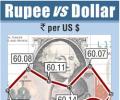
Forex dealers said besides dollar's gains against the euro overseas, increased demand from importers for the US currency and a lower opening in the domestic equity market also put pressure on the rupee.

India's current account deficit, which is the excess of foreign exchange outflows over inflows, touched a historic high of 4.8 per cent of GDP in 2012-13, mainly due to rising imports of gold and petroleum products.
Short-term government bonds fell behind longer-dated securities in demand this month so far due to a liquidity crunch in the banking system and expectations of a delay in a rate cut, said market participants. Investors have favoured longer-tenure government bonds, or g-secs, with insurance companies and pension funds leading the charge by stocking up on those with maturities of 30 years and more. Preference for longer-term securities was strengthened by the conclusion of the borrowing programme, which compelled institutional investors to fulfil their requirements in the secondary market.

The 30-share Sensex ended up 46 points to end at 28,122 and the 50-share Nifty gained 20 points to close at 8,514.

Investors turned cautious after India's trade deficit widened to a more than three-and-a-half-year high of $16.6 billion due to costlier crude oil imports

'If we play our cards right, we may even benefit from the competition between the US and China as seen from increased investment from each of these countries into India.' 'The size of our market gives us an important lever of power which we shall have to play adroitly and intelligently,' points out Ambassador Gautam Bambawale -- who served as India's envoy to China -- in the Professor V M Dandekar Memorial Lecture 2019, delivered on March 8, 2019 in Pune.
A healthy growth in India's services segments has helped the country's total exports and imports of goods and services to cross the $800 billion mark during the first half of 2023, despite a slowdown in global demand, think tank GTRI said in a report on Monday. According to the analysis of the Global Trade Research Initiative (GTRI), exports of goods and services rose by 1.5 per cent to $385.4 billion during January-June this year, as against $379.5 billion in January-June 2022. Imports, however, dipped by 5.9 per cent to $415.5 billion during the six months of this year, as against $441.7 billion in January-June 2022.

The improvement in the current account deficit is expected to provide a major reprieve to the government and the Reserve Bank of India which have been battling to prop up the rupee.

Investors should view the increase in the LTCG tax rate in conjunction with the increase in capital gains exemption from Rs 1 lakh to Rs 1.25 lakh, which will provide some relief.

Imports stood at $37.8 billion, leaving a trade deficit of $10.56 billion as against $20.2 billion in October 2012, official data showed.

It would be a miracle indeed if we grow at 7/8 per cent a year over the current and next few years, says A V Rajwade
India's exports increased by 26.9 per cent in August, while the import bill soared by 51.2 per cent leaving a trade deficit of $13.94 billion for the month.

Prices may go up because of higher energy costs, caused by the rise in shipping charges, with commercial vessels taking a longer route to avoid the troubled Red Sea region, the finance ministry said on Monday. Iran-backed Houthi rebels of Yemen are repeatedly attacking ships in the Red Sea. While the global economy is grappling with challenges such as sticky inflation, sluggish growth, and mounting fiscal pressure, India's external sector could face "potential risks" due to the ongoing geopolitical tensions, according to the finance ministry's report on the review of the Indian economy.

With Beijing remaining intransigent on the withdrawal of additional troops deployed by the People's Liberation Army (PLA) since the deadly border clash in 2020 in eastern Ladakh, India's bilateral ties with China remained frozen in 2023 with no forward movement on the horizon despite several rounds of diplomatic and military talks.
It was primarily due to a higher trade deficit ($41.6 billion) brought about by a larger increase in merchandise import.
